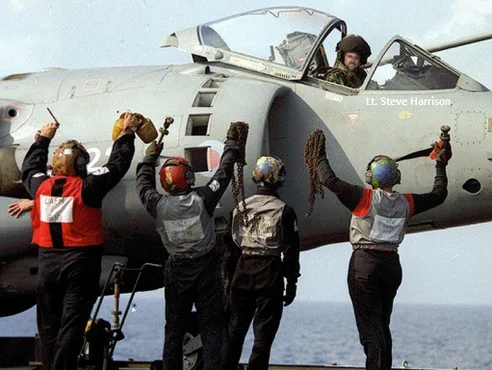
rom aerial combat in the Falklands to the cocaine wars of Colombia, decorated fighter pilot and author Stephen Harrison has lived the kind of life most novelists wouldn't dare invent. Now, more than four decades later, he's telling the stories — and discovering that remembering the danger can sometimes be almost as frightening as surviving it.
At 20, He Was Fighting a War. Today, He's Writing About It.
Most people spend their twenties discovering who they are, beginning careers, and making plans for the future.
Stephen Harrison was doing something rather different.
At just 20 years old, he was strapped into the cockpit of a Royal Navy Sea Harrier, flying into combat over the South Atlantic during the 1982 Falklands War. As one of the youngest frontline fighter pilots in the conflict, he found himself engaged in deadly aerial battles where the difference between survival and disaster could be measured in seconds.
By the end of the conflict, Steve had been credited with shooting down three Argentine aircraft and was subsequently awarded the Distinguished Service Cross for his actions.
But the Falklands War was only the beginning of an extraordinary aviation career.
What followed was a remarkable journey through some of the world's most challenging and dangerous flying environments — from the drug wars of Colombia to the unpredictable skies of Africa, from the demanding world of experimental flight testing to international commercial aviation.
Today, Harrison Thomas has embarked on another adventure: transforming those extraordinary experiences into a series of gripping autobiographical books.
And unlike most adventure writers, he doesn't need to invent the danger.
"I don't need to invent adventures. I've spent a lifetime surviving them."
The Reality Behind the Fighter Pilot Legend
Hollywood has spent decades romanticising fighter pilots. The fearless heroes, spectacular dogfights, glamorous lifestyles and triumphant returns.
Steve remembers a rather different reality.
War, he explains, is neither glamorous nor particularly romantic. It is exhausting, frightening, and frequently chaotic. Decisions must be made in fractions of a second, often with consequences that cannot be reversed.
And courage, he believes, is widely misunderstood.
"In the movies, heroes are larger than life. In a real war, they're usually ordinary people doing extraordinary things because someone has to."
His first book, Falkland Skies, takes readers directly into the cockpit of a Sea Harrier during one of Britain's most dramatic modern military conflicts.
But this isn't simply a story about aircraft and aerial victories. It is an intensely personal account of youth, fear, friendship, survival and the extraordinary responsibilities placed upon young men during wartime.
It is also a reminder that behind every military statistic is a human story.
From Enemy Fighters to Colombia's Cocaine Wars
For most people, surviving aerial combat would have been more than enough excitement for one lifetime.
Not for Steve.
His subsequent aviation adventures took him far beyond the structured world of military operations and into environments where the dangers were often less predictable.
In Cocaine Skies, he recounts his experiences flying in Colombia during the turbulent era of drug cartels, guerrilla violence and political instability.
Here, the threats were no longer enemy fighter aircraft identified on radar screens. They came from a far more complicated world of criminal organisations, armed groups, corruption and uncertain loyalties.
Then came African Skies, another extraordinary chapter in a flying career where unusual characters, unexpected challenges and sometimes absurd situations became part of everyday life.
Throughout these adventures, Harrison discovered that the world doesn't always behave in ways a novelist could convincingly describe.
"The trouble with fiction is that it has to be believable. Real life, fortunately, is under no such obligation."
And that is precisely what makes his books so compelling.
These aren't carefully constructed thrillers with imaginary protagonists. They are the recollections of a man who was actually there.
The Adventures Didn't End in the Cockpit
Steve's aviation career also took him into the highly specialised world of experimental test flying, where pilots deliberately explore the limits of aircraft performance and handling.
Later came the transition into civilian airline operations, introducing an entirely different collection of challenges, personalities and adventures.
The stories continue through his Skies series, including Beckoning Skies, with further accounts of his test-pilot and airline years forming part of his continuing writing projects.
Taken together, the books chronicle an extraordinary journey through several very different worlds, all connected by one constant: a fascination with flying and an apparently limitless appetite for adventure.
Yet there is another side to these stories.
Behind the excitement, the humour and the danger lie the more personal experiences of a life spent confronting uncertainty.
When Writing Becomes a Journey Back in Time
Perhaps the most surprising aspect of Steve's transition from pilot to author was the emotional impact of revisiting experiences from more than forty years earlier.
Writing about combat is very different from experiencing it.
In the cockpit, survival depends upon training, instinct and immediate action. There is little opportunity to contemplate fear or reflect upon the consequences of what is happening.
But decades later, sitting safely behind a keyboard, the memories can take on an entirely different significance.
The radio calls. The tension. The faces of old friends. The intense concentration of aerial combat. The terrible knowledge that some of those who shared those experiences would never come home.
Writing a memoir can reopen doors that have remained closed for decades.
And sometimes, what lies behind those doors is unexpectedly powerful.
"When you're young, you live the adventure without knowing how the story will end. When you're older, you write the story knowing exactly how close you came to never being able to tell it."
That perspective gives Harrison Thomas's books something beyond their obvious appeal as true-life adventure stories.
They offer the reflections of someone who has had decades to consider what those experiences meant, what they cost, and how they shaped the course of his life.
A Life Less Ordinary — And No Regrets About Living It
Would Steve change anything if he could go back and speak to the young fighter pilot preparing to fly into combat in 1982?
Inevitably, there are decisions he would reconsider, opportunities he might approach differently, and people he wishes he could see again.
But would he exchange his extraordinary life for something quieter, safer and more predictable?
Not for a moment.
His books are not simply celebrations of danger or the thrill of aviation. They are about taking opportunities, confronting uncertainty, encountering remarkable people and discovering how unpredictable life can be.
Most importantly, they are about having stories worth telling.
"Don't spend your life wondering what might have happened. Go out and make something happen."
The Stories Are Far From Over
Today, Stephen Harrison Thomas continues to write, drawing upon an aviation career spanning military combat, international adventures, experimental aircraft and commercial flying.
His growing Skies collection offers readers a rare opportunity to experience some of the most extraordinary chapters of modern aviation through the eyes of someone who lived them.
There is humour, tragedy, danger, friendship and occasionally the kind of breathtaking absurdity that only real life can produce.
For readers who love aviation, military history, authentic adventure or simply an extraordinary true story, Harrison Thomas's books open the door to a world few people have ever experienced.
And perhaps the most remarkable thing is that, after everything he has been through, he still has more stories to tell.
"I spent much of my life trying to stay alive in the cockpit. I never imagined that, forty years later, I'd find myself holding my breath again, sitting safely behind a keyboard."
Discover the Books by Stephen Harrison Thomas
Falkland Skies — A young Royal Navy fighter pilot's firsthand account of aerial combat, courage and survival during the 1982 Falklands War.
Cocaine Skies — From military combat to the dangerous world of Colombia's drug wars, an extraordinary true-life aviation adventure.
African Skies — Adventures, extraordinary characters and unpredictable challenges in the skies over Africa.
Beckoning Skies — Further stories from a remarkable lifetime in aviation.
More Adventures from the Skies Series
Testing Skies — Welcome to the extraordinary world of experimental military test flying, where pilots deliberately push aircraft to their limits to discover what they can — and sometimes cannot — do. From advanced Sea Harrier developments to demanding flight trials, Stephen Harrison Thomas reveals the exhilarating, technically challenging and occasionally terrifying reality of being a military test pilot.
Civilian Skies — Leaving the Royal Navy behind, Stephen Harrison Thomas trades supersonic fighters for commercial airliners, only to discover that civilian flying brings a whole new collection of challenges and adventures. From British regional airlines to international operations, unexpected emergencies and extraordinary encounters, this is the story of a fighter pilot discovering that life after the military is anything but ordinary.
Stephen Harrison Thomas is a former Royal Navy Sea Harrier fighter pilot, Distinguished Service Cross recipient, experimental test pilot, airline captain and author of the Skies series of autobiographical aviation adventures.