He had survived aerial combat in the Falklands War, flown against Colombia's powerful drug cartels and experienced more danger than most people encounter in a lifetime. Surely it was time for a quieter life? Not quite. For former Royal Navy fighter pilot Stephen Harrison-Thomas, a chance encounter in a Colombian prison would open the door to a world of African generals, diamond dealers, gold mines, political conspiracies and the extraordinary possibility of helping overthrow a president.
It All Started in a Colombian Prison
Most people wouldn't expect a visit to one of Colombia's most notorious prisons to provide the starting point for a new business venture.
But then, Stephen Harrison-Thomas had never lived a particularly conventional life.
By the time his adventures in South America were drawing to a close, he had already experienced more than his fair share of excitement.
At just 20 years old, he had flown Sea Harriers into combat during the 1982 Falklands War, shooting down three Argentine aircraft and subsequently receiving the Distinguished Service Cross.
Later came experimental military test flying, international commercial aviation and a remarkable period flying anti-narcotics operations in Colombia, confronting the dangers of drug cartels and guerrilla conflict.
Eventually, however, that chapter of his life was approaching its conclusion.
Returning to a conventional airline career was an option. It would certainly have been safer, more predictable and considerably less complicated.
There was just one problem.
He wasn't particularly enthusiastic about the idea.
And then a conversation inside a Colombian prison set in motion a chain of events that would carry him across the Atlantic and into an entirely different world.
Africa was calling.
And it was about to offer him far more than he had bargained for.
Some people retire from danger. Others apparently regard it as a career opportunity.
Welcome to Africa — Where Anything Might Happen
Africa is a continent of extraordinary contrasts.
Immense natural wealth exists alongside profound poverty. Modern cities coexist with remote regions where infrastructure can be scarce. Political stability and economic opportunity sit uncomfortably close to conflict, corruption and uncertainty.
For a restless former fighter pilot searching for new possibilities, it presented an intriguing combination of adventure and opportunity.
What began as an exploratory venture would eventually take Harrison through Uganda, the Democratic Republic of Congo, Ghana, Ivory Coast, Kenya and beyond.
Along the way, he encountered an extraordinary collection of characters.
Military officers and generals. Government officials and political figures. Diamond traders, gold dealers, miners, entrepreneurs, smugglers and traditional chiefs.
Some were ambitious businessmen pursuing legitimate opportunities.
Others operated in a much more complicated world where politics, money, military power and personal ambition were frequently intertwined.
And sometimes it was remarkably difficult to determine which was which.
For a man accustomed to dealing with dangerous situations from the cockpit of a fighter aircraft, Africa presented a very different kind of challenge.
Here, the danger wasn't always visible.
There were no radar screens to identify potential threats.
No military command structure to clarify who was on whose side.
And no guarantee that the person sitting across the table was quite who he claimed to be.
From Fighter Pilot to Political Intrigue
One of the most astonishing episodes described in African Skies involves Harrison's unexpected proximity to discussions concerning military intervention in the Democratic Republic of Congo.
What had begun as a search for commercial opportunities developed into conversations involving diamond concessions, political power and the possibility of removing a sitting president.
It was an extraordinary situation.
The former Royal Navy fighter pilot who had once been engaged in aerial combat over the South Atlantic now found himself navigating an unfamiliar landscape of military ambitions and African political intrigue.
The stakes were enormous.
Control of natural resources could mean immense wealth.
Political alliances could change rapidly.
And the consequences of trusting the wrong people were potentially far more serious than simply losing money.
For Harrison, it was another remarkable reminder that the greatest dangers in life do not always come from an approaching enemy aircraft.
Sometimes they emerge from a conversation that initially sounds like a perfectly ordinary business proposition.
In the Falklands, at least you knew who was trying to shoot you down. In Africa, working out who was on your side could be considerably more complicated.
Diamonds, Gold and the Temptation of Fortune
Beyond the political intrigue lay another powerful attraction.
Africa's extraordinary mineral wealth.
Diamonds and gold have fascinated adventurers, merchants and fortune seekers for centuries.
The possibility of discovering valuable deposits or establishing a successful mining venture has drawn people from around the world, often with spectacular results — and equally spectacular failures.
Harrison soon discovered that the business of precious minerals was considerably more complicated than simply finding something valuable and selling it.
Diamonds could pass through the hands of traders, middlemen and dealers operating within intricate networks of relationships and trust.
Gold might be transported in unexpected ways, crossing borders and moving through markets where the distinction between legitimate commerce and questionable dealings was not always immediately obvious.
And behind the promise of extraordinary profits were equally extraordinary risks.
A seemingly promising opportunity could collapse through political interference, unreliable partners, financial complications or circumstances beyond anyone's control.
For a former fighter pilot accustomed to making rapid decisions under pressure, these new challenges required a very different set of skills.
Technical flying ability was of little use when assessing a diamond deal or negotiating with an unfamiliar business partner.
And unlike an aircraft, a business proposition did not necessarily come with an operating manual.
Ghana — The Search for a Legitimate Fortune
Among the many adventures recounted in African Skies is Harrison's attempt to establish a legitimate mining operation in Ghana.
Here, the challenge was no longer simply identifying opportunities.
It was attempting to turn ambitious plans into a functioning enterprise.
Mining requires far more than enthusiasm and the promise of valuable minerals beneath the ground.
There are legal requirements, financial commitments, logistical difficulties, equipment needs and relationships with local authorities and communities.
Even a promising venture can encounter formidable obstacles.
For Harrison, the experience provided a fascinating introduction to the realities of operating a business in an unfamiliar environment.
It also brought him into contact with a remarkable range of people whose experiences, motivations and understanding of the world were often very different from his own.
Some encounters were encouraging.
Others were frustrating.
And occasionally, the situations he found himself in bordered on the absurd.
Throughout it all, the former fighter pilot was learning that navigating the unpredictable world of African business could require almost as much composure as flying into combat.
The difference was that losing control of an aircraft usually produced an immediate result.
Losing control of a business venture could take considerably longer — and sometimes prove almost as painful.
The Characters Who Made the Adventure
Perhaps one of the most entertaining aspects of African Skies is the extraordinary cast of characters who appear throughout the story.
There are influential figures with ambitious plans, businessmen promising fortunes, military officers contemplating political change and individuals whose personal histories seem almost too remarkable to believe.
Some offer genuine friendship and assistance.
Others present opportunities that deserve rather more careful examination.
And a few leave the reader wondering whether they belong in a business memoir, a political thriller or an elaborate comedy.
Harrison's experiences demonstrate that adventure is not simply about dangerous places or extraordinary events.
It is often about the people encountered along the way.
Their ambitions, personalities, contradictions and occasionally breathtaking confidence can be every bit as fascinating as the situations themselves.
There is also humour.
Not the carefully manufactured comedy of a fictional adventure, but the dry, sometimes dark humour that develops when intelligent people find themselves in circumstances that are becoming progressively more ridiculous.
Anyone familiar with Harrison's earlier books will recognise that combination of danger, candour and an ability to appreciate the absurdity of situations that might have caused a more cautious individual to retreat immediately.
The trouble with an extraordinary adventure is that you rarely recognise just how extraordinary it is until you're safely out of it.
The Former Fighter Pilot Who Couldn't Settle Down
There is a deeper story running through African Skies.
Why would someone who had already survived war, dangerous aviation operations and countless extraordinary experiences deliberately seek another adventure?
Why not simply return to the relative security of an airline cockpit?
The answer lies partly in the character of a man whose life had been shaped by challenge, independence and the search for purpose.
Harrison had spent his formative years in an environment where difficult situations demanded decisions, responsibility and a willingness to accept risk.
The Falklands War had introduced him to the realities of life and death at an age when most young people were still discovering themselves.
Experimental test flying had demanded intellectual discipline and the courage to investigate the unknown.
Commercial aviation had brought professional achievement, but not always the same sense of excitement and purpose.
Colombia had offered an entirely different world of danger, complexity and adventure.
Africa represented another opportunity to discover something new.
Not necessarily because he wanted danger for its own sake, but because the prospect of an ordinary, predictable existence had never held quite the same attraction.
There was always another horizon.
Another possibility.
Another extraordinary character with an improbable proposition.
And occasionally, another decision that would later prompt the inevitable question:
What on earth was I thinking?
A Continent of Opportunity and Contradiction
Although African Skies contains plenty of danger, political intrigue and questionable business propositions, the story also provides glimpses of the remarkable diversity and complexity of the countries Harrison visited.
Africa is not one country, one culture or one experience.
The political circumstances of Uganda differ enormously from those of Ghana. The challenges of operating near conflict-affected regions of Congo are very different from establishing a legitimate business venture in West Africa.
Throughout his travels, Harrison encountered people pursuing their ambitions, supporting their families, building businesses and attempting to create opportunities in circumstances that were often far from straightforward.
The contrast between extraordinary natural wealth and the difficulties of converting that wealth into lasting prosperity forms an important backdrop to the story.
As does the complicated relationship between politics, military power and commercial opportunity.
But this is not an academic study of African economics or political history.
It is a firsthand account of an outsider attempting to navigate an unfamiliar world, sometimes successfully, sometimes less so, and frequently learning lessons he could never have anticipated.
That perspective is precisely what makes the book so readable.
When Real Life Is Stranger Than Fiction
If African Skies had been presented as a fictional thriller, readers might reasonably question whether the plot was becoming a little too extravagant.
A former Royal Navy fighter pilot leaves Colombia's cocaine war.
A chance encounter in prison leads him towards Africa.
He becomes involved in conversations about diamond concessions and political intervention.
He travels between countries, meets extraordinary personalities, explores mineral trading and attempts to establish a mining business.
Along the way, he encounters intrigue, uncertainty, opportunity and situations that could have been borrowed from an adventure film.
Yet these are the experiences upon which Harrison's memoir is based.
And unlike a fictional hero, he does not always know what he is doing, make the right decisions or emerge from every situation with a triumphant result.
That honesty is an important part of the book's appeal.
The mistakes and disappointments are as much a part of the adventure as the excitement and successes.
Because real life rarely follows a carefully constructed narrative.
Sometimes the ambitious plan fails.
Sometimes the apparently reliable individual turns out to be anything but.
And sometimes the most valuable thing you bring home from an adventure is the story of what happened.
The Final Great Adventure?
In many ways, African Skies represents the culmination of a remarkable journey.
A working-class boy from Yorkshire grows up dreaming of becoming a fighter pilot.
He achieves that ambition and finds himself fighting a war in the South Atlantic before his 21st birthday.
He goes on to become an experimental test pilot and an airline captain.
He flies in Colombia during the country's violent struggle against powerful criminal organisations.
And then, when most people might reasonably expect him to settle down, he heads for Africa in pursuit of diamonds, gold and new opportunities.
It is an extraordinary sequence of events.
But the most remarkable aspect may be that none of it was part of a grand master plan.
One opportunity led to another.
One encounter opened a door.
One unexpected decision changed the direction of his life.
And a willingness to explore unfamiliar possibilities repeatedly carried him into situations that would eventually become the material for his autobiographical books.
The lesson is not that everyone should chase dangerous opportunities or become involved in unpredictable political situations.
Quite the opposite.
Harrison's experiences reveal how easily ambition, curiosity and misplaced confidence can lead a person into circumstances far beyond anything originally imagined.
But they also demonstrate the extraordinary stories that can emerge when life refuses to follow a conventional path.
Some people spend their lives searching for adventure. Stephen Harrison-Thomas seemed to have a remarkable talent for finding it — even when he wasn't entirely sure what he'd found.
African Skies — One More Adventure Worth Telling
African Skies is far more than a story about diamonds, gold or African political intrigue.
It is a candid, sometimes humorous and frequently astonishing account of a man who repeatedly ventured beyond the boundaries of an ordinary life.
There are ambitious business ventures, remarkable personalities, dangerous situations, political conspiracies and unexpected encounters.
There are successes, mistakes, disappointments and moments that seem almost too extraordinary to be true.
And throughout it all is the unmistakable perspective of a former fighter pilot who had already experienced war, survival and adventure — yet somehow continued to find himself drawn towards the unknown.
For readers who enjoy true-life adventure, political intrigue, international business, travel memoirs or stories of extraordinary lives, African Skies offers a journey into a world few outsiders ever encounter.
It is unpredictable, sometimes alarming, often amusing and never particularly ordinary.
And perhaps that is the real appeal.
Because the most extraordinary adventures rarely begin with a carefully prepared plan.
Sometimes they begin with an unexpected conversation in a Colombian prison.
He survived the Falklands. He survived Colombia's cocaine wars.
Then he went looking for diamonds in Africa.
What could possibly go wrong?
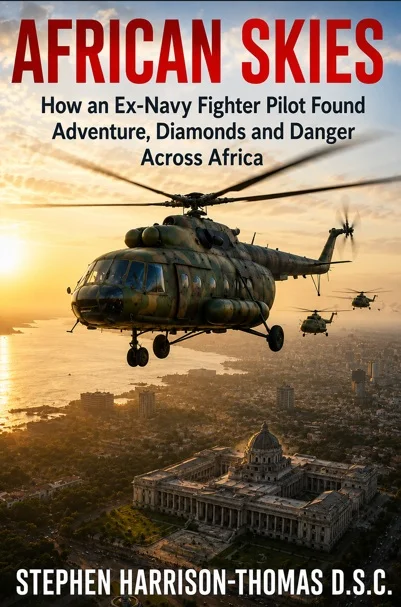
Discover African Skies by Stephen Harrison-Thomas
African Skies: How an Ex-Navy Top Gun Became Entangled in War, Coups and Diamonds in Africa
From Colombia's drug wars to Africa's diamond fields, gold mines and political intrigues, discover the remarkable true story of a former Royal Navy fighter pilot whose search for one more great adventure led him into a world where fortunes could be made, governments challenged and danger was never far away.
Stephen Harrison-Thomas DSC is a former Royal Navy Sea Harrier fighter pilot, Falklands War veteran, experimental test pilot, airline captain and author of the autobiographical Dangerous Skies series.