The very first one was Orwell, George, a copy of whose ‘Animal Farm’ was thrust into my thirteen year old hand by a schoolmate who grimaced precociously even as he told me he couldn’t believe – so he claimed – that I hadn’t read it yet. Ashamed by my apparent ignorance, I read this short novel, and soon forgot about whether or not I was supposed to have read it or not: the animals who talked like believable adults, the farmer who was more animalish than they, the scheming, the cheating, the hypocrisy, the rivalries and the final impossibility of distinguishing between pigs and humans, all of this written in a language that described the most outlandish situations in a markedly (almost overly) commonsensical way, had me hooked, by which I mean it felt as if that book, and its writer, were stage-whispering in my ear – mine alone. I went on to read almost everything Orwell wrote: his dystopias, his flying aspidistras, his Wigan trips, his Catalan homage, and all four volumes of his essays, articles and correspondence. And yet, even as I went on reading his incisive, straightforward and sometimes agreeably scathing prose I began to sense that there had to be a stage further that a writer could go: something cruder, something even more honest, and, above all, something linguistically more daring, something riskier.
It was Orwell himself – in a review tucked away in one of those four volumes of essays, articles and letters – who recommended a writer who was doing precisely that.
Orwell was the first English person to praise Henry Miller’s ‘Tropic of Cancer’, which at the time of his review had just been published by a small English language publishing house in Paris which dealt mainly in pornography. ‘Cancer’ itself would be banned in the English-speaking world for thirty-one years after Orwell’s unconditional eulogy of it. But by the 1970s, when I was still a teenager, it was on sale at all good bookshops, as were its follow-ups ‘Black Spring’ and ‘Tropic of Capricorn’, not to mention later books like ‘The World of Sex’, ‘Quiet Days In Clichy’ and the exceptional, unputdownable ‘Sexus’, not to mention the two only slightly less inspired books of the trilogy to which that book belonged: ‘Plexus’ and ‘Nexus’. Over the years I have read just about every word Miller ever wrote or spoke publicly: his articles, his correspondence, his interviews, and every other piece of what he called ‘autofiction’ that he wrote until his death in 1980, not to mention the biographies and the testaments written by friends, admirers and lovers: Brassaï, Alfred Perlès, Twinka Thibaud, Erica Jong, Anaïs Nin… It was his language that kept my eyes magnetised by the constant surprises it came up with, the sudden outbursts of humour, the sexual and scatological details – described with an unsettling mix of matter-of-factness and otherworldly observations – and above all, his written stretchings: the way he could turn a drunk giving a speech in a bar into page after page of a meaningful event; or how the sight of an old man – or an exposed vagina – could have him rolling in metaphysical speculations like a puppy in wet grass. In other words, he was living proof that language could be – if the writer so wished – putty in his or her hands, and that this putty could be twisted into the most fantastical, the most startling and the most gripping of shapes.
How could anyone take writing any further than that?
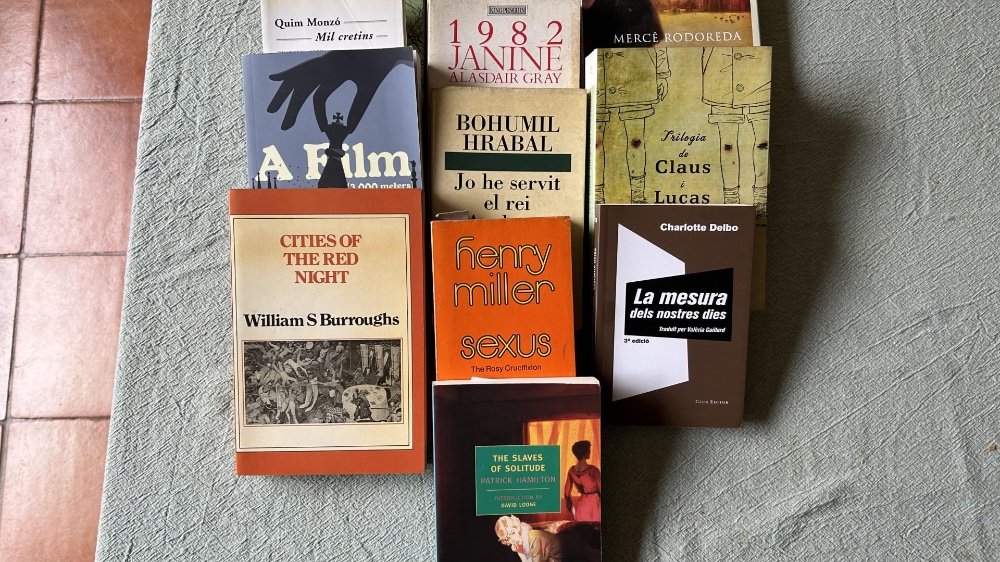
Well… Although I was aware of the title ‘The Naked Lunch’ and its author’s name, it didn’t occur to me to start reading him until 1981, when ‘Cities of the Red Night’ came out to some fanfare, at least in City Limits, the now defunct London listing magazine once read by everyone who prided themselves on being to the left of the Labour Party, myself included. By that stage I was out of psychiatric day care and might still have been in the half-way hostel I’d been assigned to, or maybe by then I’d moved into a friend’s rented flat in Clapham. Either way, I was too short of money to buy books, and so began my three year career as a literary shoplifter – only from one huge bookshop, mind, whose aristocratic owner wasn’t short of a bob or two – with the liberation of a copy of William Burroughs’s latest effort from the shelf upon which it languished. If Miller’s language was a display of linguistic freedom, Burroughs’s was one of freedom from linguistics altogether: his characters crossed all the conventional barriers of time and space, changed costume and often their physical appearance at the drop of a hat, and plots weren’t hatched so much as hacked into disjointed segments. Sure as I was that I had discovered the outer limits of what a writer could do, I went on to read everything Burroughs had produced, together – as I’d done with Orwell and Miller – with his interviews, articles, and biographies. Not to mention his three cut-up novels, which even he later described as excessive but which still made some kind of sense despite being made up of clippings, admixtures, and random inserts.
Later writers were to follow: I discovered Bohumil Hrabal simply because I liked the title of one of his novels, and then went on to read everything of his I could lay my hands on, he who wasn’t afraid of narrative incoherence nor of endless sentences nor even of the occasional novella consisting of just one sentence.
And then there was Thomas Bernhard, who I started reading when I discovered a play of his had shocked audiences so much it caused disturbances in certain Austrian theatres, he who lathered his texts about his native country with unrestrained hatred, he who used the deliberate repetition of words and phrases with a view to hammering home everything he chose to say.
And then again there is Quim Monzó, the Catalan language writer whose stories captivate readers so much because he never once uses clichéd language (such as ‘putty in his hands’), not ever, which makes him the perfect imaginary text checker, leaning over your shoulder as you write.
And then – and I’m not just popping them in now in the interests of parity – there are the dream-like, unwillingly cruel novels of Mercè Rodoreda; Agota Kristof’s ‘Claus and Lucas’ trilogy, reeking of the dregs of the last century; Caterina Albert’s flash-like 3000 metre film; Charlotte Delbo’s memoirs of Auschwitz and beyond…
In a nutshell, all these writers and others taught me that when you write you can do exactly as you wish, that nothing whatsoever is off limits, not linguistically, not stylistically, not in terms of subject matter or content or format. Nothing whatsoever!
I’ve just said they taught me all this, those authors, but I couldn’t for the life of me even get close to what they had done, stylistically trapped as I felt myself to be in the class-retarded sludge of British English. So by way of an experiment I forayed out into my second language (Catalan) where I found I immediately felt freer – in writing terms – than I ever had with English. With Catalan, I at least had the sensation that I was getting somewhere.
In general, the only British writers who didn’t goo up their language with class markers were the Scottish ones, like A.L. Kennedy, Irvine Welsh and, above all, Alasdair Gray (of whom I have read almost everything, including biographies etc. etc.). As if their use of the Scottish variant of English, be it mild or hardcore, had released them from the hidebound language of certain much-praised writers south of the border who I found all but unreadable (Ian McEwan, Julian Barnes, Martin Amis and so very many more).
In 2006, I took the risk of switching back to English and have since produced seven novels in that language, five of them trapped on Amazon, two still being revised. This time, I was convinced I was writing exactly about what I wanted to, I was avoiding linguistic clichés, my plots had the kind of twists and turns I’d always longed for, and that, in general, these books were surprising in the kind of way I liked books to be. The reviews were positive. Reader feedback was highly favourable (in the main).
That said, I was aware it was perfectly possible that I had ended up falling, after all those long years of writing, into a deplorable state of self-delusion about my supposed gifts as a writer.
Until one day, I got some much needed reassurance.
*
Celrà is a village of just over 5000 people, located in north-east Catalonia, close to Girona. Unexpectedly, it boasts a vast second-hand bookshop which opens three times a week and sells all its volumes, thick or thin, for 2€ each. Most of its stock is in Catalan and Spanish (in that order) but it also has sections in French, German, Dutch, Italian, Portuguese, Basque, and English. It was when browsing in this latter section that I stumbled across a novel called ‘The Slaves of Solitude’. I had never heard of its author (Patrick Hamilton) but as it was set roughly in the same period I was setting my latest novel in and had a luridish 1950s type of cover which proved irresistible, I forked out the pittance the bookshop was asking for it.
David Lodge’s 2007 introduction to the book made it clear that Hamilton had been through several traumatic experiences, was a heavy drinker – aren’t we all? – and didn’t give a toss (or a tinker’s cuss) about what literary category he belonged to with the result that, according to Lodge ‘[this novel] is unlikely to…attract the attention of theory-driven critics’. This last comment put Hamilton, it seemed to me, in the same fish kettle as Miller (‘I start tomorrow on the Paris book: First person, uncensored, formless – fuck everything!’) and Burroughs (‘language is a virus from outer space’) and Hrabal, Bernhard and all the rest of the writers I liked, none of whom gave a toss (or a tinker’s cuss) about their putative ‘category’.
On top of which, Hamilton belonged to that unhappy band of authors who had once been appreciated and even feted but then went, in Lodge’s words, ‘into eclipse’, even as they continued to write. I identified with this, probably because I’ve always been in eclipse, without the bit about being appreciated or feted (not in English, at any rate).
As soon as I started reading the actual text of ‘The Slaves of Solitude’, I realised I had struck solid gold, this turning out to be the first time I had really and unconditionally enjoyed an English writer since Orwell, forty-nine years earlier. Here, in black and white, was an unforgettable portrait of English people, be they both ghastly or attractive or plain, described through descriptions and dialogues written with the gloves off and no Queensbury Rules. Every single one of them reminded me of someone I’d met somewhere; and were in fact even more real than those someones met somewhere. The overarching archness of the crypto-Nazi Mr Thwaite, the lonely travails of Miss Roach, the vile wiliness of Vicki Kugelmann…Even the name of the boarding house where all these people ended up – the Rosamund Tea Rooms – rang vague, childhood bells. And the opening sentence was reminiscent of Bernhard’s rants about Salzburg: ‘London, the crouching monster, like every other monster has to breathe, and breathe it does in its own obscure, malignant way’.
And the language! All the English ways of speaking were there, in that book and the others, plucked from characters representing each and every social class: the slightly off oos and ‘ain’ts and double negatives of the prostitutes, the waiter and the barmaid in ‘Twenty Thousand Streets Under The Sky’, contrasting with the forcedly posh tones of an out of work actor and the terrible puns of the local pain in the neck; the woman who speaks in phony oirish to her Irish help in ‘Hangover Square’; the slick, honed talk of the homonymous con man in the Gorse Trilogy… On top of which, Hamilton has no problem with turning nouns into verbs and vice-versa, no problem with deliberate repetitions, no problem with recherché expressions which he often stands on their heads; indeed, no problems with linguistic registers and no problems whatsoever with language in general: Hamilton was born in Sussex but he might have come from anywhere, raining as he does a bitter, comic realism down on his characters, who are English but might stand – what with their solitude, their false gregariousness, their bucket-bound feet and their occasional small triumphs over life’s run-of-the-mill adversities – for anyone, anywhere.
Unfortunately, now that Patrick Hamilton is back in the running, now that almost all his novels and the occasional play (‘Gaslight’, anybody?) are back in print, the authors and critics who preface and praise his work do so because they see him mainly as a fine observer of ‘interwar London life’. How English, to resuscitate a writer only to shove him into a parochial, Brexitish niche! Hamilton was more than an observer, he was a perpetrator, bystander and victim rolled into one, and his books – it doesn’t matter where they’re set – take in everything, tell all. In other words and at the risk of falling head first into another linguistic cliché, he was a universal writer, like Miller, Burroughs, Hrabal, Bernhard, Rodoreda, Gray, Kristof, and so very many more: writers who broke out of the places and the times they happened to find themselves in, so that they could stage-whisper in all our ears, no matter where we are and what our times.
I doubt that I have even got close to what these and the other writers mentioned have thus done, but at least Hamilton was the proof I badly needed that despite being English and writing, therefore, in British English, you can still make the language malleable, alive, and as convincing as anything touchable you care to name.
And if I don’t know quite where I am at the moment, I am realistically sure that I’m a hell of a lot better than I used to be, thanks to this baker’s dozen or so of writers to whom I owe a debt that will remain unpayable until the day I die.